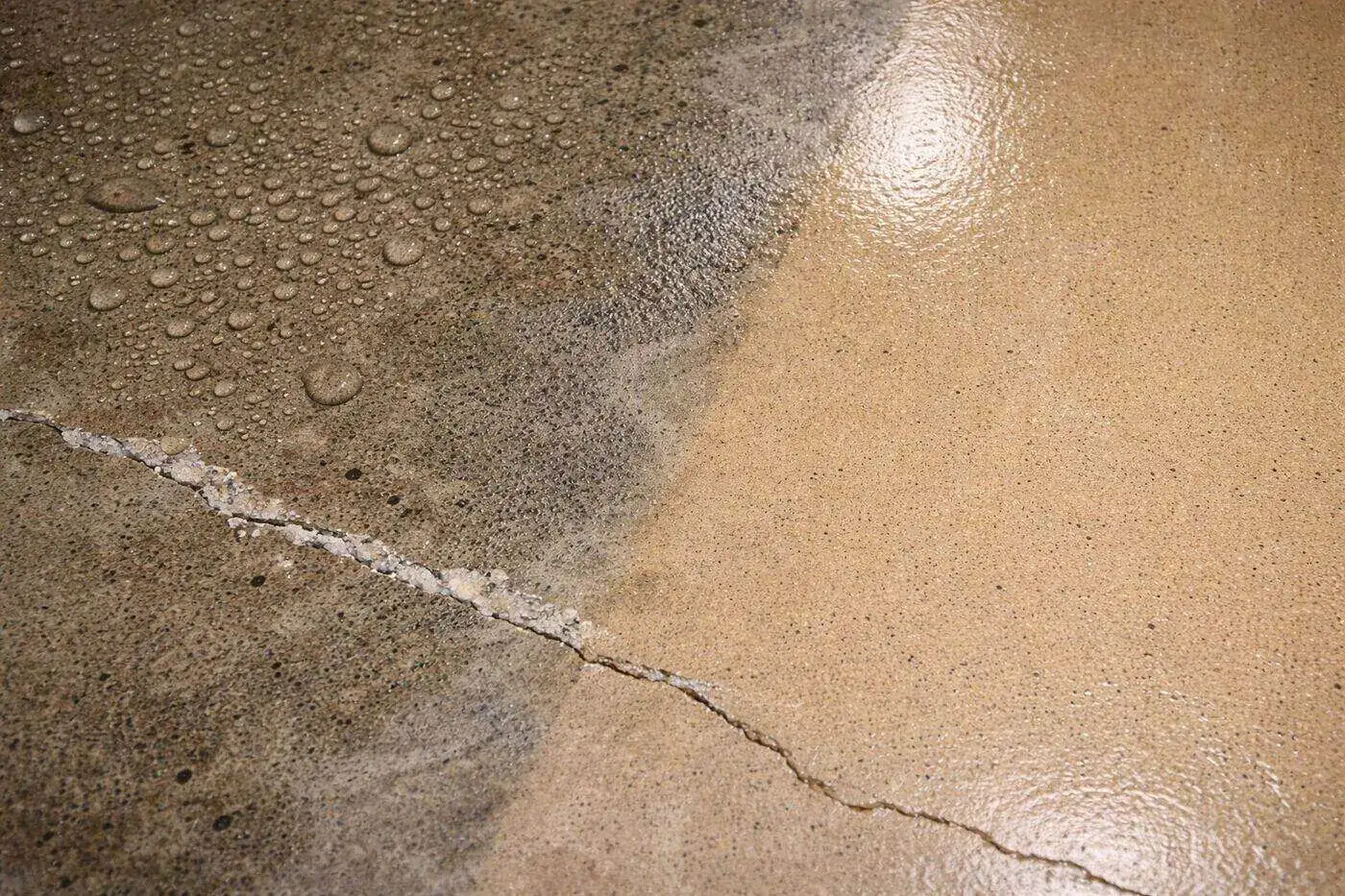
In metro Atlanta the epoxy almost never fails. The slab under it does. Across metro Atlanta, a floor that bubbles and peels was coated before anyone checked what the concrete was doing from below — and on clay that holds water against the slab, that step is not optional.
Picture a 1960s Decatur garage poured straight onto red clay, or a finished basement slab in Sandy Springs. The floor looks bone dry on installation day. Six months later it is blistering in patches and lifting along the edges. The homeowner blames the brand of epoxy or the crew that rolled it on. The truth sits a few feet underground, in the groundwater that pushes vapor up through every slab in this part of the state. This guide walks through why metro Atlanta's clay subgrade and freeze-thaw winters are harder on a floor coating than most people expect, the slab-moisture tests that catch the problem before a single drop of resin goes down, and the exact questions that tell you whether an installer understands the ground they are working on — or is about to sell you a redo.
The Real Cause of Epoxy Failure in metro Atlanta
Start with the mechanics, because they explain everything that follows. Epoxy cures into one continuous, glass-hard film that grips the top of the concrete. That grip only holds if the slab beneath stays dry and stable while the resin sets and for the life of the floor afterward. Now add metro Atlanta's reality: water sitting in the limestone evaporates, climbs through the pores of the slab, and presses on the back of the coating with steady, real force. Give it a few weeks of that pressure and the film starts to let go — first as small blisters, then cloudy white halos, then whole sheets peeling up at the seams.
The trade has a name for it: moisture vapor transmission, and it is the single most common reason an epoxy floor dies young. Notice what it is not. It is not a bad batch of resin, not a sloppy roller technique, not a defective product you can return. It is a slab that got coated before anyone confirmed it was ready to be coated. And here is the part that should make you angry on behalf of every peeled garage in Sandy Springs: it is completely measurable in advance. A contractor who reads the slab can engineer the right system for it. One who skips the reading is rolling dice with your floor and your money.
Why a metro Atlanta Slab Fights You Harder
Geography is the whole story here. metro Atlanta sits on the Piedmont plateau at about 1,000 feet, on red clay over granite bedrock. Walk the map and you can see the problem: Sandy Springs is laced with more creek-bottom lots than any city in the country, Brookhaven and Roswell hug the river, and Johns Creek and Alpharetta are fast-grown north-metro suburbs where slabs were poured quickly on red clay on the other. Under a slab bedded on clay, the moisture rarely drains away — in plenty of neighborhoods groundwater sits just below the slab. That is a permanent underground reservoir feeding vapor up into the concrete, twelve months a year, never switching off.
The way homes here were built makes it worse. A lot of metro Atlanta slabs were poured straight on grade with a thin or aging vapor barrier underneath, and on older Atlanta and Marietta houses there may be no working barrier left at all. So the equation is brutal: maximum moisture pushing up from below, minimal defense built into the slab to stop it. That is why on a large share of metro Atlanta floors, vapor mitigation is not an optional upgrade — it is the baseline for getting any coating to hold.
Two local wrinkles raise the stakes further. First, freeze-thaw: water that soaks into an unsealed slab expands when it freezes and spalls the surface, and Atlanta averages about fifty freeze nights a year, and it will read high even once it looks and feels dry. Second, finished basements, where the slab is below grade and moisture pushes up through it year-round — those slabs and their interiors run damp, and a floor poured without checking will betray its owner the first season back. None of this is guesswork. Put a meter on a metro Atlanta slab that looks perfectly dry and it routinely reads well past the safe vapor line. The eye says ready. The instrument says wait.
The 75% Relative Humidity Threshold
Here is the number that decides everything. The coatings industry does not judge a slab by how it feels to the hand — concrete looks and feels far drier than it actually is. It judges by internal relative humidity, the moisture trapped deep inside the slab. The working ceiling is roughly 75 percent. Below it, epoxy bonds and stays bonded. Above it, the failure odds rise fast, and on clay-bedded metro Atlanta slabs that line gets crossed more often than people expect.
Two things conspire against you in Atlanta. From below, damp red clay keeps the slab loaded with moisture. From above, the air itself is heavy — metro Atlanta humidity hovers around the mid-70s much of the year, and the region's heavy summer rain keeps everything saturated. When you try to coat in that kind of air, epoxy can throw what installers call amine blush: a greasy, cloudy film that means the resin never cured right and will not hold. On the humid, rain-soaked days that define a metro Atlanta summer, that risk is at its peak.
So a real metro Atlanta installer does not just check tomorrow's forecast. They put a probe in the slab, read the internal moisture, inspect the surface, and time the pour to a window the concrete can actually survive. Coat a slab sitting north of 75 percent and you have not installed a floor — you have scheduled a failure for a few months out.
Not Sure What Your metro Atlanta Slab Is Doing?
We read the concrete before we quote a number. Get a straight answer about your slab and a system engineered for an Atlanta floor.
The Moisture Tests That Catch the Problem
You never have to take a moisture problem on faith. Construction has hard, standardized tests that put a number on exactly how much water a slab is moving, and any installer worth hiring in metro Atlanta runs at least one of them before quoting. Three are worth knowing by name.
Relative Humidity Probe Test (ASTM F2170)
On a metro Atlanta slab, this is the test that matters most. Small holes are drilled into the concrete, sealed probes go in, and after they equilibrate they report the humidity deep in the slab — not the surface, the core, where the vapor pressure actually lives. Because it captures the exact condition that breaks coatings loose, ASTM F2170 is the reading most epoxy manufacturers tie their warranty terms to. Come in under roughly 75 percent and the slab is clear to coat. Come in higher and you mitigate before anything else happens.
Calcium Chloride Test (ASTM F1869)
The older standby. A sealed dish of calcium chloride sits on the slab for a set period and weighs the moisture rising out of the surface, expressed as pounds per 1,000 square feet over 24 hours. Three pounds is the common ceiling; above it, vapor pressure is high enough that delamination becomes a real threat and a vapor barrier is in order. It still has its place, but on a metro Atlanta floor it has largely yielded to the in-slab RH probe, because surface emission tells you less than what is happening down where the bond either holds or fails.
Plastic Sheet Test (ASTM D4263)
The fast field gut-check. Tape a square of clear plastic tight to the concrete, wait a day, then look: condensation under the sheet or a dark patch on the slab means moisture is on the move. It is handy for flagging an obvious problem on a Atlanta walkthrough, but it is a yes-or-no screen, not a measurement — it cannot tell you how wet, only that it is wet. A floor you are paying real money for earns a real number, not a plastic square and a shrug.
| Test | What It Measures | Safe Range |
|---|---|---|
| RH Probe (ASTM F2170) | Internal slab humidity | Below ~75% RH |
| Calcium Chloride (ASTM F1869) | Surface moisture emission | Under 3 lbs / 1,000 sq ft / 24 hrs |
| Plastic Sheet (ASTM D4263) | Visible moisture (screening) | No condensation under sheet |
How a Vapor Barrier Fixes a Wet Slab
A wet reading is not a death sentence for your floor. It is a spec. The answer is a moisture-mitigation primer — a vapor-barrier coat engineered specifically to handle the conditions a metro Atlanta slab throws at it. The slab gets a diamond grind first to open the surface and give the primer real bite, then that specialized primer goes down, seals the concrete, and shuts the vapor out. Only then does the decorative epoxy go on, now bonding to a barrier instead of to damp concrete that was always going to let go.
Yes, it costs more — generally another $1.50 to $3.00 per square foot, on top of a moisture test that runs roughly $200 to $400 in value (we fold that test in free when we evaluate your slab). But frame it honestly: on a clay-bedded Atlanta floor that mitigation primer is not an upgrade that makes the floor pricier. It is the layer that makes the floor possible at all. Skip it and you are not saving money — you are pre-paying for a redo before the next humid summer.
This is exactly why a serious metro Atlanta contractor tests before quoting, never after. Without a reading, every price is a guess, and the suspiciously cheap guesses are almost always the ones that quietly left mitigation out. So when two Atlanta quotes are side by side, the slightly higher one that includes the test and the right vapor barrier is, nine times out of ten, the cheaper floor measured over the years you actually own it.
What to Ask Before You Hire a Contractor
You do not have to become a concrete scientist to protect yourself in Atlanta. You just have to ask five pointed questions and pay attention to whether the answers are specific or hand-wavy. Run any installer through these before you sign anything.
- Do you test the slab for moisture before you quote? The right answer is an unhesitating yes, with a method named — an ASTM F2170 in-slab RH probe or an ASTM F1869 calcium chloride test. If the question gets brushed off, you have your answer, and it is the wrong contractor.
- What reading is too high to coat without mitigation? A pro reaches for the roughly 75 percent RH line or the 3-pound calcium chloride limit without thinking. A blank look here, in a county this wet, should end the conversation.
- When a metro Atlanta slab tests wet, what is your move? You want to hear "diamond grind, then a vapor-barrier mitigation primer." You do not want a shrug and "it'll probably be fine" — that sentence is how peeled floors get sold.
- How do you prep the concrete? A diamond grind, opening the surface for a true mechanical bond. An acid wash or a quick scuff does not cut it on a clay-bedded slab in this climate.
- Is the topcoat UV-stable? The metro Atlanta sun ambers coatings that are not built to take it. A polyaspartic or polyurea topcoat shrugs off both the humidity and the glare.
An installer who fields these cleanly is telling you, without a brochure, that they understand the metro Atlanta slab under their feet. That understanding — far more than the resin brand or the price per square foot — is what decides whether your floor still looks flawless five seasons from now. And if you want the dollars-and-cents side, our companion guide on how much epoxy flooring costs in Atlanta breaks down every finish and the local cost drivers, moisture mitigation included.
Frequently Asked Questions
Why do epoxy garage floors peel so often in Sandy Springs and Atlanta?
Because of where the slab sits, not the epoxy itself. Most of metro Atlanta is built barely above elevation on porous limestone, so groundwater is often only a few feet under the floor. That moisture rises as vapor and pops the bond loose from below, which is why coatings bubble and peel in Sandy Springs, Brookhaven, and older in-town neighborhoods within a season or two. Testing the slab first is what prevents it.
Does winter road salt near Decatur affect an epoxy floor?
Road brine will not eat a properly cured epoxy, but it destroys bare and sealed-only concrete. Older in-town slabs at Decatur, Roswell, and Sandy Springs sit closest to the slab moisture and stay the dampest, so the underside vapor pressure that drives failure is highest there. A coating built for a metro Atlanta slab is a moisture-tested, vapor-mitigated system, not an off-the-shelf garage kit.
Which moisture tests should a metro Atlanta installer run before coating?
Three are standardized. The relative-humidity probe (ASTM F2170) reads humidity deep inside the slab and should sit below about 75 percent. The calcium chloride test (ASTM F1869) should come in under 3 pounds per 1,000 square feet over 24 hours. The plastic-sheet test (ASTM D4263) is a fast screening check. On a metro Atlanta slab the in-slab RH probe is the one to trust, because it reads what is happening below the surface where the failure starts.
How much does moisture mitigation add to a Atlantan epoxy floor?
A vapor-barrier mitigation primer usually adds about $1.50 to $3.00 per square foot, and the moisture test runs roughly $200 to $400 of value. We include the ASTM test free when we evaluate your slab. On a lot of metro Atlanta floors mitigation is not an add-on, it is the step that lets the floor exist at all.
My closed-up garage sat empty all summer. Does that change the moisture risk?
It can. A house that sat closed up through a humid Georgia summer with the AC turned down often has a damper slab and higher interior humidity than a year-round house. That makes a moisture reading more important, not less. We test the slab in the condition it is actually in, so a floor poured before rental season holds through the next one.
What questions separate a real Atlanta installer from a cheap one?
Ask if they test the slab for moisture before quoting, what reading is too high to coat without mitigation, what they do when a slab tests wet, how they prep the concrete (the answer is a diamond grind), and whether the topcoat is UV-stable for the Georgia sun. Specific answers mean they understand a metro Atlanta clay-bedded slab. Vague ones mean you are paying for the redo.
Test First, Coat Once
The heat, the humidity, the clay-held slab moisture, the freeze-thaw seasons — none of it is a reason to skip an epoxy floor in metro Atlanta. Every one of them is a reason to demand the floor be done right. Tested, properly ground, mitigated where the slab calls for it, and capped with a humidity-tolerant, UV-stable topcoat, an epoxy floor will outlast and outperform nearly any other surface you could put in a metro Atlanta garage or shop, this climate included. The horror stories you hear are never the technology failing. They are a corner cut on the one step that holds the whole floor up.
At Precision Epoxy Atlanta, the job starts at the concrete, not the contract — we read your slab and run the moisture test before a single number gets quoted. You get the system your floor actually requires for this ground, not the cheapest one that fits on a flyer. Call (404) 974-2647 or request a free quote online and we will get your slab evaluated. We serve Sandy Springs, Brookhaven, Decatur, Dunwoody, Johns Creek, Alpharetta, Peachtree Corners, Roswell, Marietta, and communities across metro Atlanta.